A whole-of-society approach to Canadian prosperity

Photo courtesy for Rob Thompson on Unsplash
Consider this proposal
Canada stands at a decisive moment.
In an era of geopolitical volatility, AI disruption, and economic insecurity, Canada has an opportunity to activate a whole‑of‑society, purpose-driven and mission‑oriented innovation ecosystem, aligning public, private, academic and, for the first time, civil society actors around shared transformational innovation.
The government of Prime Minister Mark Carney came into office heralding seven priority goals, or missions. These included strengthening geopolitical and economic collaboration, security and sovereignty, interprovincial trade, housing, affordability, talent attraction and business championship. Mind the Gap: Ensuring the participation of civil society in Canada’s mission-oriented innovation ecosystem, makes the central point plainly: these transformative missions cannot be delivered by government or any single sector alone; they require a whole-of-society approach that includes civil society, philanthropy, and community knowledge as essential capacities.
“Mission-oriented innovation refers to any new or improved technological, social, or organisational solution (product, process, or service) that aims to respond to one or several objectives tackling grand societal challenges (missions) and create public value to society (e.g., climate mitigation, clean oceans, sustainable economic growth, and well-being).” - OECD, Observatory of Mission-Oriented Policy
A 2021 OECD Survey of Mission Innovation practitioners found that the most critical aspects for missions to be successful are:
1. Top-down policy and strategic coordination
2. Bottom-up experimentation involving an ecosystem of actors
3. Capacity to manage a diverse portfolio of activities
Their results confirmed that the key feature of missions is that they can combine both top-down policy and strategic coordination, as well bottom-up experimentation involving an ecosystem of actors.
Currently, our innovation ecosystem is failing because it is structurally incomplete, insufficiently reliant on government, industry, and academia, and under-powered by the civic institutions closest to lived experience. If Canada is serious about its sovereignty, resilience, affordability, housing, climate, health, and democratic trust, civil society must be treated as a co-architect of national innovation.
Civil society includes charities, nonprofits, foundations, faith communities, unions, advocacy groups, community organizations, cultural bodies, and the informal civic networks that hold society together. These actors are not peripheral to innovation; they are often the first to see systemic failure and the first to test practical alternatives.
Civil society is the missing fourth helix that supplies what the other three cannot.
Consider the capabilities waiting to be tapped. Civil society is the:
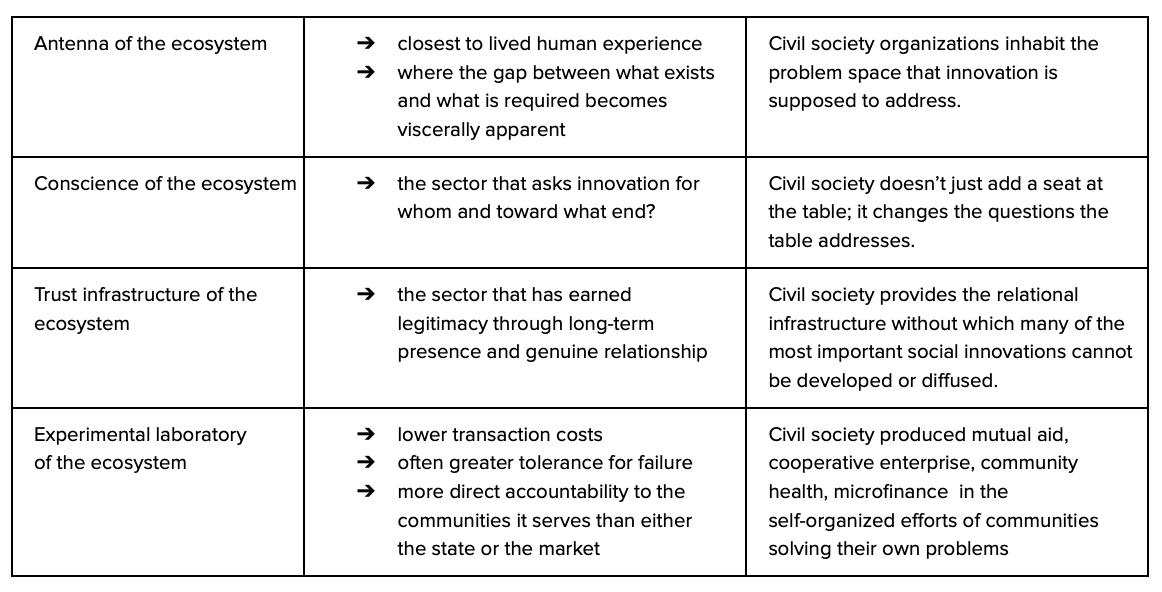
Civil society produced mutual aid, cooperative enterprise, community health, microfinance in the self-organized efforts of communities solving their own problems.
We invite Canada to formally reframe its innovation agenda as Science, Technology and Social Innovation (STSI), grounded in a quadruple helix of government, industry, academia, and civil society. That means designing national missions around public outcomes, not just economic indicators, and resourcing the civic capacity needed to co-design, test, and scale solutions.
In practice, we can work to build an “experimenting society”. That means creating the infrastructure that makes participation real: cross-sector innovation teams, community-university pathways, civic labs, social labs, and a stronger institutional home for mission orchestration.
A credible Canadian agenda would include these moves:
Establish a national mission framework that explicitly includes civil society as a partner in setting goals, designing delivery, and evaluating outcomes;
Create or designate coordinating offices to orchestrate mission-oriented innovation across sectors, similar in function to models seen in other jurisdictions;
Fund civil society’s innovation infrastructure, including talent, networks, data capacity, convening power, and experimentation grants;
Build pathways for community organizations, foundations, and social innovators to participate in public innovation systems on equal footing with traditional institutions;
Use public policy to align security, sovereignty, affordability, housing, climate, and wellbeing under a shared whole-of-society agenda.
Canada cannot meet today’s challenges with yesterday’s architecture. We need a new innovation model that places civil society at the heart of design, delivery, and accountability. This is not only a better innovation model; it is a stronger sovereignty model, a more democratic model, and a more credible model for long-term prosperity.
For Canadian prosperity, the next innovation leap will come when civil society is finally recognized as a core instrument of national capacity, democratic resilience, and mission success.
Mind the Gap: Ensuring the participation of civil society in Canada’s mission-oriented innovation ecosystem was co-authored by Tim Draimin and Geraldine Cahill for The Collaborative.
The paper was presented during The Common Room series. Caleb Wellum, writing on behalf of the Canadian Collaborative for Society, Innovation and Policy (CCSIP) produced a rich reflection on the presentation, available here.